How to Identify, Treat, and Prevent Rust Fungus on Plants
Various types of rust fungus cause damage to plants. It's important to tackle the problem as soon as you notice it to prevent spread around your garden. We explore these irritating fungi and how to control them!

Contents
Out of all the problems plants can experience, fungal diseases are among the most pervasive and damaging. Many of the world’s most notorious famines can be traced back to fungi and fungal-like organisms.
The Irish potato famine, for example, was caused by the fungal-like organism Phytophthora infestans, which can infect an entire field of crops in a very short time. In the United States, wheat stem rust caused by Puccinia graminis f. sp. tritici has rendered millions of bushels of wheat unusable.
As gardeners, we have a complicated relationship with fungi. On one hand, beneficial fungi and bacteria are essential for supporting healthy plant growth. On the other, some fungi can seriously damage crops if left unmanaged. In this post, we take a closer look at rust diseases, including how to identify early symptoms and manage infections before they spread through the garden.
Mercury 1L Trigger Sprayer

Mercury 1L Trigger Sprayer
Mercury sprayers include a unique double action spray head for a constant, fine spray with minimal effort! In addition, the 360° feature means that you can spray at any angle…Even upside down! The sprayers are ideal for tending indoor plants, spraying, foliar fertilizing, applying leaf shine, etc.
Buy at Epic Gardening Shop
What Is Rust Disease?

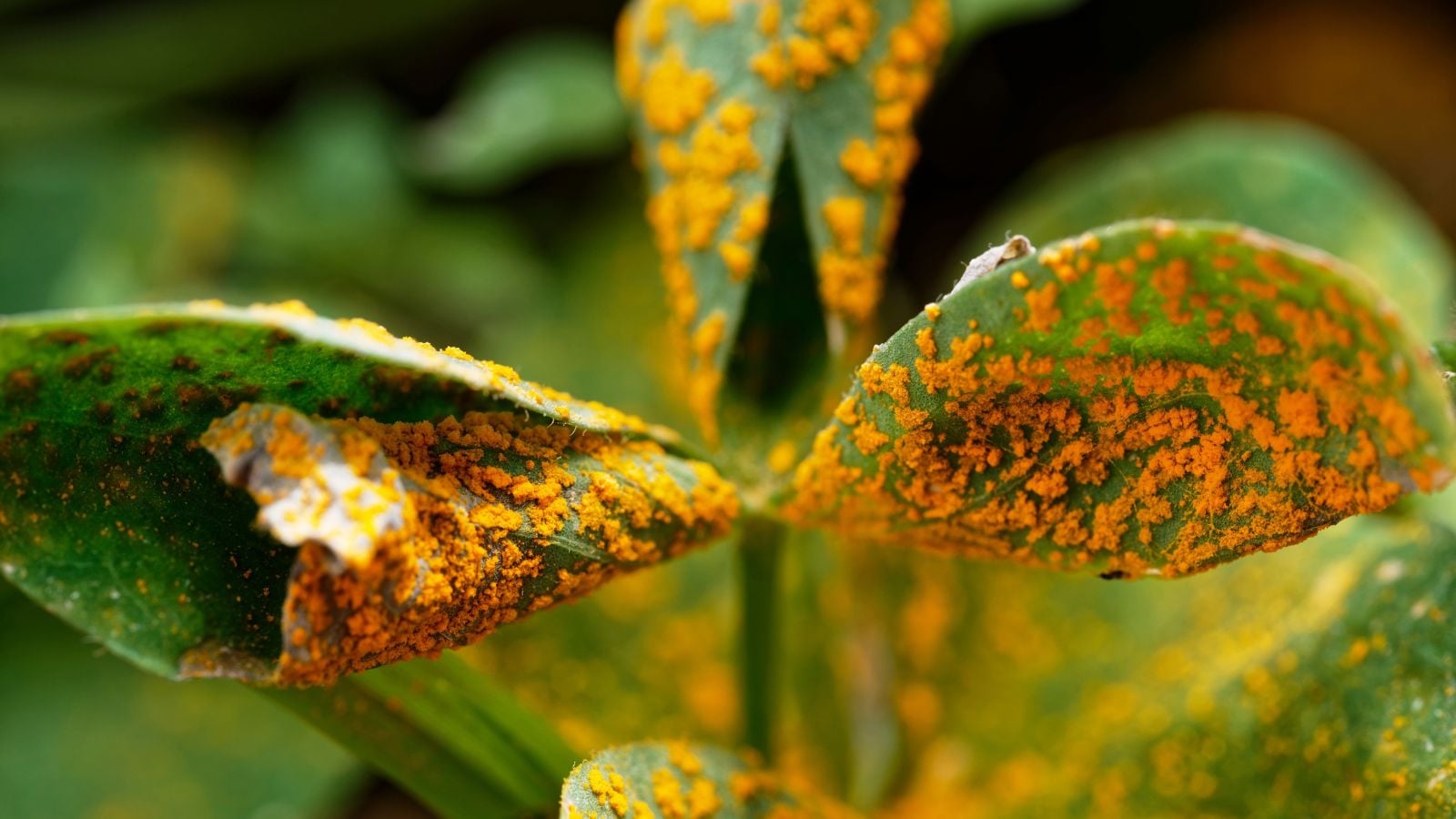
Rust on plants occurs through a completely different process than rust on metals. The brown, orange, or red patches that appear on leaves or stems are actually clusters of spores. Fungi are not plants and cannot produce food through photosynthesis. Instead, they absorb nutrients from their surroundings using thread-like structures called hyphae.
A mass of hyphae is known as a mycelium. As gardeners, you may already be familiar with mycelium as a beneficial presence in soil that helps plants absorb nutrients. When you see mold on food, which is another type of fungus, you are actually seeing its mycelium.
The fungal kingdom is vast and ancient. Rust fungi alone include roughly 7,000 known species, and scientists believe they have existed long enough to co-evolve alongside their plant hosts. Researchers also suspect that many more rust fungi species remain undiscovered, particularly in tropical and subtropical regions.
Because rust fungi attack some of the world’s most economically important crops, including corn, grains, coffee, and sugarcane, several species have been extensively studied. While rust diseases are rarely fatal, they can significantly reduce plant vigor, growth, and overall yield.
Types Of Rust Fungi

Rust fungi are obligate parasites, meaning they rely on living host plants to survive. These fungi have had hundreds of millions of years to become highly specialized, and many species are adapted to infect only specific host plants.
Both ornamental plants and food crops are susceptible to rust diseases. Rust fungi from the genera Puccinia, Uromyces, Gymnosporangium, and Cronartium have been well studied due to their significant impacts on agriculture and human societies.
Life Cycle Of The Rust Fungus

Rust fungi have very complex life cycles. Many species have five distinct spore stages that occur on two unrelated host plants and involve both sexual and asexual reproduction.
Using wheat stem rust as an example, rust spores land on healthy host plants, germinate, and penetrate plant tissue. The pathogen then begins absorbing nutrients from the host. As the fungus grows, it produces large numbers of urediniospores, causing the host tissue to rupture and release spores into the air.
This reddish-brown powder is the most visible sign of rust infection. Each spore can repeat this cycle every two weeks, which allows infections to spread rapidly. During this phase, urediniospores reproduce asexually and are genetically identical clones.
As the growing season for the primary host ends, the rust fungus produces another spore type known as teliospores. These black spores overwinter in a dormant state and initiate sexual reproduction on an alternate host the following season, introducing new genetic variation. In the case of wheat stem rust, the alternate host is the barberry plant. Sexual recombination occurs in barberry leaves and produces aeciospores, which erupt from pustules on the undersides of leaves and then reinfect the primary host.
An important takeaway for home gardeners is that rust fungi can overwinter and reemerge the following year. These pathogens do not simply complete a single growing-season cycle like some other fungal diseases. Remove and dispose of blackened or infected leaves and stems, and do not add them to compost piles, as this can allow the disease to persist.
Symptoms Of Rust

Rust is a highly visible fungal disease that most often appears from late summer through autumn. The primary symptom is the development of orange, red, yellow, or brown pustules or circular spots on the leaves and stems of infected plants. In some cases, rust pustules may also appear on flowers and even fruit.
On plants such as roses, rust infections can cause leaves to drop prematurely, often progressing upward from the lower foliage. Other ornamental plants commonly affected by rust fungi include carnations, asters, geraniums, and snapdragons. Rust is also a frequent issue in turfgrass and lawns, where it shows up as powdery yellow spots on grass blades.
Controlling Rust Disease

Rust fungi, like many other fungi, thrive in hot, humid conditions. Visible symptoms often increase in late summer when rain, sustained humidity, and heat combine. Rust can be managed using a combination of cultural and chemical control practices.
As soon as you identify rust symptoms, remove infected leaves, stems, or flowers to limit further spore spread. If your garden has a history of rust problems, begin preventative fungicide applications at the start of the growing season. Apply treatments every seven to ten days for a total of five to six applications.
While many fungicides are available, relatively few are approved for organic use. Organic fungicides typically rely on sulfur as the active ingredient, though copper-based fungicides can also be effective against rust. Always read product labels carefully and follow application directions closely.
Preventing Rust
Prevention of rust fungi starts with selecting resistant varieties whenever possible. If you are choosing turfgrass for a lawn, there are several rust-resistant cultivars of bluegrass and perennial ryegrass now available.
Many gardeners enjoy growing beans, but rust fungi can be a concern. If rust is a known issue in your garden, consider resistant cultivars such as the ‘Kentucky Blue Wonder’ pole bean or the ‘Golden Wax’ early bush bean. Contact your state’s extension office for recommendations tailored to your local climate and growing conditions, especially if fungal diseases are a recurring problem.
Additional cultural practices also help reduce the risk of rust. Space plants adequately to encourage good airflow, and avoid overhead watering to keep foliage as dry as possible. Maintain a consistent deep-watering routine, such as using drip irrigation, to support strong root systems and overall plant health. Once a plant becomes infected with rust, its reduced vigor can make it more susceptible to viral diseases and insect pests.
Frequently Asked Questions
Is rust fungus dangerous to humans?
While rust spores can be transported by humans if they land on our clothes or shoes, it is not dangerous to humans or pets.
Will lawn rust go away on its own?
Lawn rust may go away on its own without the application of fungicides under the right cultural conditions such as deep watering, fertilization and an increase in mowing height.
Does rust fungus die in winter?
Rust fungi have an overwintering stage during their life cycle where they are dormant but will reactivate the following year under the right temperature and humidity conditions.





