How to Prune Your Wisteria in January
Wisteria needs pruning twice a year to keep it flowering abundantly and under control. Gardening expert Madison Moulton explains why January is the ideal time for winter pruning and how to prune wisteria properly while it's dormant.


Contents
Wisteria is breathtaking when it blooms, which is why gardeners love it so much. But left unpruned, wisteria can quickly become a tangled disaster that threatens to pull down whatever structure it’s climbing.
That’s why proper (and regular) pruning is essential. It turns wisteria into a well-behaved plant and channels energy into flower production.
January is one of those crucial pruning windows. While summer pruning in July or August controls rampant growth during the active season, winter pruning in January tidies everything up and sets the stage for spring’s flower display.
Understanding what each pruning session accomplishes, and how they work together, helps you maintain a wisteria that’s both beautiful and manageable. Follow this guide to learn how to prune wisteria in January.
Amethyst Falls Wisteria

Meet the Charming Amethyst Falls Wisteria
Ready to add a touch of whimsy to your garden? The Amethyst Falls Wisteria is a delightful climber that brings a cascade of deep purple flowers to any backyard oasis. Unlike its more unruly cousins, this variety is well-behaved and perfect for smaller spaces.
Buy at Epic Gardening ShopPruning Timing

Wisteria needs two distinct pruning sessions each year to perform its best. Each serves a specific purpose, and timing matters for success.
Summer pruning happens in late July or August after flowering finishes and while the plant is actively growing. This session controls the long shoots that wisteria produces throughout the growing season. Summer pruning is your main tool for managing size and preventing wisteria from taking over.
Winter pruning takes place in January or February while the plant is fully dormant. Without leaves obscuring the structure, you can see exactly what you’re working with and make strategic cuts that improve the framework. This session refines the work you did in summer, further shortens shoots to promote flowering, and removes any problematic growth.
January wisteria pruning specifically is ideal because the plant has been dormant long enough that you won’t stimulate new growth, but spring is still far enough away that you’re not risking damage to swelling buds. The timing gives you a clear view of plant structure while ensuring your cuts heal properly before the growing season resumes.
Why Winter Prune

Winter pruning accomplishes things that summer pruning can’t, primarily because the plant’s dormant state and lack of foliage completely change what’s visible and how the plant responds to cuts.
Tidying up the plant is easier and more effective when you can see the entire framework. During the growing season, dense foliage hides the structure underneath, making it difficult to assess which branches are productive and which are creating congestion.
Improving shape is much easier when you can actually see the shape. Wisteria trained along a wall, over an arbor, or up a pergola needs a strong structural framework that supports all that growth and weight. Winter is when you can evaluate whether the main framework is doing its job or whether you need to remove competing leaders or thin areas that have become too crowded.
Wisteria can live for decades, and older wood gradually becomes less productive at producing the flowering spurs you want. Winter pruning lets you identify aging sections and remove them strategically, encouraging the plant to invest energy in younger, more vigorous wood that flowers more reliably.
Most importantly, when you prune wisteria in January, you maximize flower production. Wisteria blooms on short spurs that develop along the previous season’s wood. By shortening shoots to just a few buds, you force the plant to develop these flowering spurs rather than wasting energy on long vegetative growth.
How to Prune

To prune wisteria in January, follow this sequence that builds on what you accomplished during summer pruning.
Have your tools ready before starting. Sharp shears handle most cuts on current season’s growth, while loppers or a pruning saw might be necessary for thicker branches you’re removing entirely. Wipe blades with rubbing alcohol between plants or at minimum at the start of the pruning session.
Cut Back Shoots

The primary goal of winter pruning is to shorten all the side shoots you cut back during summer pruning. These shoots have grown since summer, even though growth has slowed, and they need one more reduction to optimize flowering.
Look for the shoots emerging from the main framework branches. Count back from the tip to find the second or third bud, then make your cut just above that bud at a slight angle.
The buds you’re looking for are slightly swollen bumps along the stem. In January, they’re still fairly tight and small, but visible enough to count accurately. Make your cut about a quarter inch above the bud.
Repeat this process for every shoot around the plant. It’s tedious work on a large, established wisteria, but stick with it. Missing sections will mean uneven flowering and areas that grow out of bounds, exactly the opposite of what we want when we prune wisteria in January.
Remove Worn Out Growth
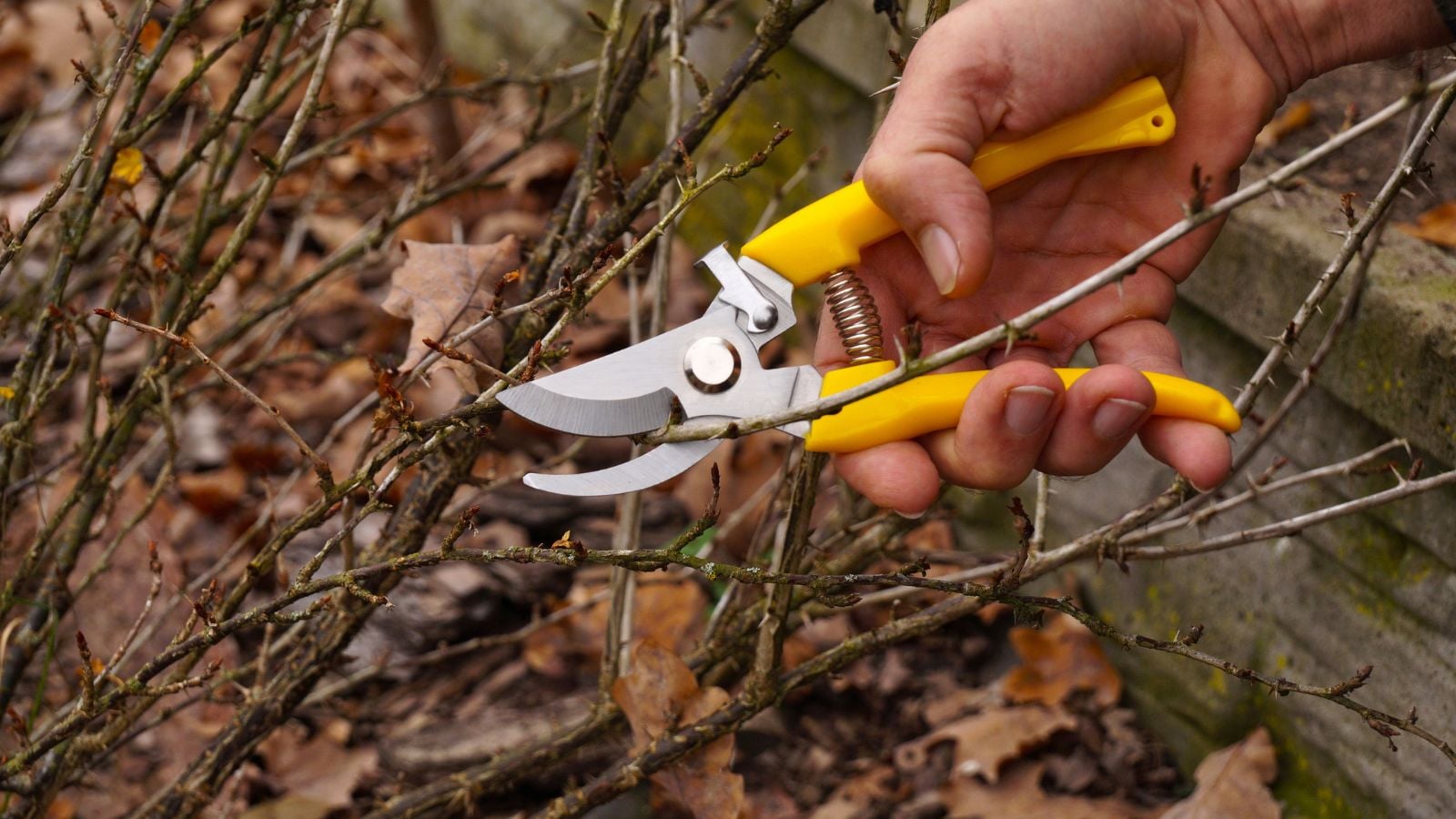
While you’re working around the plant, watch for older branches that aren’t contributing productively anymore. These might be dead or dying sections, areas damaged by weather or age, or just older wood that’s become unproductive.
Look for brittle, gray or brown branches without any buds or shoots. Cut the branch entirely, removing it back to living wood. Dead branches don’t serve any purpose and create weak points where the structure can fail.
Diseased or damaged wood should also be removed. Look for cankers, split bark, or areas that seem infected or unhealthy. Cut back to clean wood below the damage, removing the problem entirely rather than leaving it to potentially spread.
Don’t go overboard with this. Removing every branch that seems slightly less vigorous turns into excessive pruning that stresses the plant. Focus on obvious problems and truly worn-out sections rather than trying to perfect every branch.
Trim Back Overgrowth

Even with summer and winter pruning, wisteria often produces growth that escaped earlier attention or emerged late in the season. January is your chance to catch these sections and bring them back into line with the rest of the plant.
Look for shoots that have grown far beyond where you want the plant to reach. These might be reaching into gutters, under roof shingles, in front of windows, or wrapping around structures they shouldn’t touch. Cut them back to an appropriate point, either shortening to a few buds like regular shoots or removing them entirely if they’re growing in completely wrong directions.
Watch for shoots wrapping around the main framework in ways that will eventually girdle those permanent branches. Young shoots are flexible and wind around whatever’s nearby, but as they thicken, they can constrict the branches they’re wrapped around. Unwind and remove these before they cause structural damage.
Improve Shape

Step back periodically during the pruning process to evaluate the overall shape that’s emerging. Winter pruning is your best opportunity to correct structural issues or refine the silhouette since you can see what you’re doing without foliage interference.
If certain areas have become too dense while others are sparse, selectively remove entire branches from crowded sections to open them up. Wisteria flowers are meant to hang freely, and they can’t do that effectively if they’re trapped in a thicket of branches and leaves.
Check whether the weight distribution makes sense. Heavy growth concentrated on one side of a structure creates an imbalance that can lead to structural failure over time. Remove some of the excess from heavy areas and train new growth into sparse zones to even things out.
For wisteria trained in specific forms (like a standard, espalier, or over an arbor), winter is when you can see most clearly whether the form is being maintained. Remove any growth that breaks the intended silhouette, and consider whether any retraining is needed to keep the plant growing in the desired direction.





