How to Propagate Philodendron Plants
Philodendrons are among the most common plants grown across the world. In North America, they’re most often houseplants, but in sub-tropical and tropical regions, they are great for growing outdoors. An overgrown philodendron needs some tending to, and expert gardener Sarah Jay walks through how to propagate philodendron houseplants here!


Contents
Growing one plant allows you to grow multiple over time. If you know how to propagate philodendron plants, you get to learn even more about the species in this genus, and best of all, it gives you more plants. These propagates can be gifts, or more for your collection.
If you’ve been into houseplants for any period of time, it’s likely you know about philodendrons. Heartleaf philodendrons are common houseplants, and the lovely ‘Brasil’ cultivar is a regular sight in big box stores these days. Multiple propagation methods work as well.
Philodendrons are a vast group, with over 600 species. While they vary widely, there are a few types that are easy to identify and acquire. Here, we focus on propagating the most common philodendrons. Follow along step-by-step, and when spring begins, multiply your collection!


Determine Your Type

There are two main types of philodendrons: climbing and non-climbing. If you have a mature plant, it should be obvious what type you’re growing. Climbers tend to produce new leaves on vines, and non-climbers grow upright stems where leaves develop.
Climbing philodendrons produce prominent aerial roots that cling to surfaces as they vine upward. Houseplant climbers grow happily on moss poles and potted trellises. Predominant species include heartleaf (Philodendron hederaceum) and redleaf philodendron (P. erubescens).
Upright types – also called “arborescent” – are happy when situated in a planter. Because they don’t climb, they don’t need any extra accoutrements. As they develop, their stems become semi-woody. The most common of these is tree philodendron (P. bipinnatifidum). It has striking fenestrated leaves, much like a monstera. These produce aerial roots, but not for climbing. They cling to nearby trees for support.
Before you propagate philodendron houseplants, you need to know their type. Here are some of the most common ones you’ll see in the store, and the category they belong to.
| Climbing Philodendrons | Non-Climbing Philodendrons |
| Heartleaf philodendron (P. hederaceum) | Tree philodendron (P. bipinnatifidum) |
| Silver Sword philodendron (P. hastatum) | Redleaf philodendron (P. erubescens) |
| Fiddleleaf philodendron (P. bipennifolium) | Birkin philodendron (P. ‘Birkin’) |
| Burle Marx philodendron (P. burle-marxii) | Hope philodendron (P. bipinnatifidum ‘Hope’) |
The best time to propagate philodendron plants is during active growth, between spring and early fall. As cooler weather and light diminish ahead of mid-fall, dormancy sets in, and root growth lessens. While it’s not completely off limits to propagate in dormancy, it’s not the best time.
Division

When you look for information about how to grow them, it’s unusual to find division as a viable way to propagate philodendron houseplants. However, it is possible to do so, and both types respond well to this method. You can do this as you up-pot root-bound plants.
You’ll need a pair of gloves and a good, sharp knife or a pair of pruners. Make sure your tools are sanitized. Remove the plant and root mass from its container. Then gently dust off the soil from the roots with your hands. Look for areas where roots are connected to stems or vines.
Separate the individual root masses or cut them with your preferred tool. Ideal divisions have at least one or two sets of leaves. Transplant these into new containers no more than a couple of inches wider than their root ball.
Propagate Cuttings

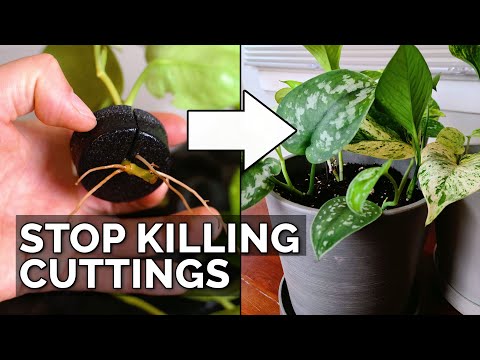
In active growth, propagate philodendron plants via cuttings. This method works for vining and arborescent plants, but is best for climbers. If you’re trying to grow new tree philodendrons via cutting, select a leaf stem that is still green, rather than a woody one. For either type, stems three to six inches long are best.
Cutting roots develop in water or in soil. For water propagation, change the water daily to keep the rooting medium clean. For both methods, remove all the bottom leaves from the cutting, leaving one set at the top. This diverts the plant’s energy toward root growth, rather than leaf production.
Place the cutting in water and wait for at least one substantial root to form, and then plant it in a small pot. For soil propagation, make a hole in a small container filled with philodendron soil about two inches deep. Then set your cutting in and press the soil around it to keep it in place. Throw a dome over your starter pot to promote ambient humidity.
The timing for root development varies widely. Some types develop roots within a week, and others take up to four weeks. Gently tug soil-propagated plants to see if they’re properly rooted. When you feel some resistance, you know your prop operation was successful.
Growing Offsets

Because vining types tend to sprawl and spread upward or outward, they don’t produce offsets. Tree types, however, do produce baby plants that can be gently separated from their parent. Therefore, you can propagate philodendron plants via their offsets if they are arborescent.
Do this when you’re repotting and up-potting your tree types. The process is similar to division, but instead of cutting root masses away, use your hands to pull the offset away. Then repot it.
Layering

Use different types of layering to propagate philodendron plants. Vining types respond best to mound layering, and non-climbers propagate more easily via air layering. Once you’ve determined the type you’re growing, it’s easy to carry out either.
For climbers, select a stem several inches long. Then find an empty spot in your pot. Simply bury a section of stem with no leaves, allowing the rest to be free. Pin the stem in the soil with a rock or landscaping staple and cover it with soil. Over time, adventitious roots develop. Unearth the section and detach it to transplant.
Air layering is best for tree philodendrons. Find an area of new, green stem and cut it partially with a sharp, sterilized knife or pruners. Then wrap the area with hydrated peat moss or coco coir. Affix the wrap with a piece of plastic or a layering pod. Within a week or two, roots will form, and the rooted area can be transplanted as a new plant.
Key Takeaways
It’s easy to propagate philodendron plants because they’re some of the easiest plants to grow indoors. If you’re thinking of multiplying your collection, remember:
- Determine whether you have a climbing or non-climbing philodendron.
- Divide plants with multiple root masses during repotting.
- Propagate cuttings of either type in water or in soil. Vining types respond better to this propagation method.
- Grow offsets of non-climbers.
- Mound layer vining philodendrons and air layer tree types.





