How to Plant, Grow, and Care For Philodendron Brasil
Philodendron Brasil has become a more popular houseplant over the last several years. Their beautiful leaves make this philodendron variety a well-sought after plant. In this article, gardening expert Madison Moulton walks through all the steps you'll need to follow to successfully plant, grow, and care for Philodendron Brasil.


Contents
Few philodendron cultivars are as well known as Philodendron hederaceum ‘Brasil’, a trailing vine full of personality. Its deep green leaves with yellow-green centers instantly brighten any room, whether displayed on a shelf or hanging basket.
‘Brasil’ is more widely available than many rarer philodendron varieties and has become a favorite among beginners and experienced houseplant enthusiasts alike. One of the most visually striking philodendron cultivars, it is also straightforward to grow and maintain.
Beyond its bold foliage, this plant stands out for its low maintenance care needs. Easy to manage and forgiving of minor mistakes, Philodendron ‘Brasil’ makes an ideal choice for new plant parents ready to expand their indoor collection. Let’s explore everything you need to know about caring for this popular trailing houseplant.
Philodendron Brasil Plant Overview

|
Plant Type
Houseplant
Family
Araceae
Genus
Philodendron
Species
Philodendron hederaceum ‘Brasil’
|
Native Area
Topical Forests
Exposure
Bright Indirect Light
Height
2-4 feet
Watering Requirements
Low
|
Pests and Diseases
Spider Mites, Mealybug
Maintenance
Low
Soil Type
Airy and Well-draining
Hardiness Zone
9A-11B
|
What is Philodendron ‘Brasil’?

Philodendron ‘Brasil’ is a cultivar of the species Philodendron hederaceum, commonly known as heartleaf philodendron. ‘Brasil’ is one of the older cultivars, first discovered in the 1990s, and it remains widely available in nurseries and online retailers today.
Heartleaf philodendrons are closely related to other plants in the Philodendron genus, including the rare and highly sought-after ‘Pink Princess’. These tropical plants thrive in warm, humid environments, which makes them especially well-suited to indoor growing.
Although philodendrons can flower under ideal conditions, growers primarily value them for their glossy green foliage. This is particularly true of the ‘Brasil’ cultivar, prized for its deep green leaves and bright variegation.
All philodendrons belong to the Arum family, Araceae. This family includes leafy tropical plants that produce a spadix, a pointed flowering structure typically surrounded by a modified leaf known as a spathe. You can see this same flower structure in plants such as Anthurium and Spathiphyllum.
Heartleaf philodendrons are often mistaken for Epipremnum aureum, commonly known as pothos. The ‘Brasil’ cultivar closely resembles certain pothos varieties, but differences in leaf shape and variegation make it easier to tell these plants apart.
History

Unlike some houseplants with unclear origins, the history of Philodendron hederaceum ‘Brasil’ is well documented thanks to its plant patent.
According to the patent record, ‘Brasil’ was discovered in 1991 by a grower in Holambra, Brazil. After numerous propagation attempts, each increasing the potential for mutation, one plant out of thousands developed a distinctive greenish-yellow variegation pattern in a controlled growing environment.
Once identified, the plant was propagated by cuttings over several generations to test the stability of its variegation. After successive plantings confirmed that the pattern remained consistent, the cultivar was named ‘Brasil’ in honor of its place of origin.
The patent was granted in 2000, showing that this cultivar has been on the market for more than two decades. It remains one of the oldest Philodendron hederaceum cultivars in circulation, especially when compared to newer introductions such as Philodendron hederaceum ‘Rio’, which was discovered in 2009 and released commercially only a few years later.
As an established cultivar, ‘Brasil’ has also produced additional sports with unique variegation patterns. Continued propagation increases the likelihood of further mutations, which is how cultivars like ‘Rio’ eventually emerged.
Native Area

Wild Philodendron hederaceum plants are native to Central America and the Caribbean. They thrive in tropical and subtropical climates, which reflects their natural habitat. Their aerial roots allow them to climb tree trunks, lifting themselves off the forest floor to capture dappled light beneath the canopy.
Today, Philodendron hederaceum is more commonly grown indoors than outdoors due to its popularity as a houseplant. The ‘Brasil’ cultivar remains one of the most widely grown varieties thanks to its striking variegation and broad availability.
Because this mutation originated in a controlled growing environment after multiple generations of propagation, you will not find ‘Brasil’ growing in the wild, even in Brazil despite its name. However, it maintains the same preference for warm, humid conditions and the same climbing growth habit as the original species.
Characteristics

Philodendron ‘Brasil’ shares a similar leaf shape with the standard green form of Philodendron hederaceum. What sets this cultivar apart is its bold variegation.
Each leaf typically features a yellow-green stripe running down the center, though the size and intensity vary. Some stripes are thin and subtle, while others are broad enough to dominate nearly the entire leaf surface.
The leaf tips appear slightly more elongated and pointed than other heartleaf philodendron types. However, the classic heart shape remains intact, defined by the curved base where the stem meets the leaf blade.
New stem growth emerges in a reddish tone, gradually shifting to orange-brown as it matures. Each new leaf develops within a protective sheath called a cataphyll, a modified leaf that dries and falls away once the leaf fully unfurls.
According to the original patent description, ‘Brasil’ reaches a height of about six inches with a spread of roughly 20 inches. When grown in ideal conditions without regular pruning, the trailing stems can extend several feet. Growth tends to be slightly slower than darker, non variegated philodendron varieties.
Like other philodendrons, this cultivar contains calcium oxalate crystals in its leaves and stems, making it toxic to humans and pets if ingested. Keep trailing vines out of reach of children and animals to prevent accidental exposure.
How to Grow
Heartleaf philodendrons are known for being easy-going plants that suit beginners well, and Philodendron ‘Brasil’ is no exception. The trailing stems look striking when allowed to cascade from shelves or hanging planters. You can also train the plant up a moss pole or trellis to encourage vertical growth and showcase larger, more mature leaves.
Light

As a general rule, Philodendron hederaceum tolerates a wide range of lighting conditions, including lower light. However, it performs best in bright, indirect sunlight similar to the dappled light of its natural tropical habitat.
For Philodendron ‘Brasil’, higher light levels are especially important. Because the variegated portions of the leaves contain less chlorophyll, they photosynthesize less efficiently. Bright indirect light compensates for this and encourages strong, healthy growth.
To maintain bold variegation, place your plant in bright indirect light for most of the day. An east-facing window that provides one to two hours of gentle morning sun also works well. South or west-facing windows should be filtered with a sheer curtain to prevent leaf scorch. North-facing windows typically do not provide enough light, and plants grown in low light may gradually revert to solid green foliage.
If you are unsure about light levels in your home, smartphone apps can measure light intensity using the built-in sensor that adjusts screen brightness. These apps report readings in lux or foot candles. For best growth, aim for 10 000 to 20 000 lux, which equals 1 000 to 2 000 foot candles. For more precise measurements, use a dedicated light meter and target the same range.
Water

Plants in the Philodendron genus are not heavy water users. They prefer soil that dries slightly between waterings rather than remaining constantly moist.
Overly wet soil creates ideal conditions for root rot and fungal disease, both of which are difficult to correct once established. It is safer to delay watering by a few days than to overwater and risk long term damage.
To keep Philodendron ‘Brasil’ healthy, water only when the top one to two inches of soil have dried completely. This approach maintains a proper balance between moisture and aeration. Check the soil every few days and water when the surface feels dry to the touch.
If you’re prone to overwatering or underwatering, there are a few ways to fix the problem:
- Never water on a strict schedule. Soil conditions can change day to day with changes in temperature, humidity or light levels. Watering on a schedule – for example, once every seven days – is bound to lead to issues with over or underwatering at some point.
- Make it a habit to test the soil. While you won’t need to water every few days, checking in on your plants and their moisture levels will make sure you know as soon as they need a drink. It also gives you some one-on-one time with your plants to assess their health and to look for any signs of pests or diseases.
- Use moisture meters. While the results they provide are not always the most reliable, moisture meters are a good way to keep an eye on the soil without having to get your hands dirty every day.
Soil

Philodendron ‘Brasil’ requires a well-draining, airy potting mix to reduce the risk of overwatering. Because the plant prefers slightly drier conditions, the soil must allow excess moisture to drain quickly while still delivering oxygen to the roots.
Standard garden soil or heavy potting mixes are not suitable for indoor growing. Containers indoors dry far more slowly than outdoor beds, so houseplant mixes need to be light and fast-draining to prevent root rot.
A good houseplant mix typically combines potting soil with perlite or orchid bark and coconut coir or peat moss. This blend improves drainage while retaining enough moisture to sustain the plant for several days between waterings.
You can buy a quality indoor plant mix from a nursery or online retailer. Alternatively, create your own by combining two parts potting soil with one part perlite and one part coconut coir. If the base soil feels too fine or compact, add a handful of bark to increase airflow between particles.
Soil adjustments are usually only necessary during repotting, as ‘Brasil’ can remain in the same mix for several months. When repotting, examine the existing soil composition and try to replicate it closely. Maintaining a similar texture and structure minimizes transplant shock.
Sudden changes in soil type can cause yellowing leaves and temporarily slow root growth as the plant adjusts to new conditions.
Temperature and Humidity

Heartleaf philodendrons originate from tropical rainforest environments, where warm temperatures and high humidity dominate. In these regions, temperatures rarely fall below 65°F (18°C) and seldom rise far above 90°F (32°C).
For Philodendron ‘Brasil’, aim for consistent daytime and nighttime temperatures between 65 and 85°F (18 to 29°C) to encourage steady growth and healthy foliage. The plant can tolerate temperatures up to 90°F (32°C), but prolonged exposure may cause stress due to its thin leaves, which do not store much moisture.
Growth slows significantly below 55°F (13°C), and temperatures under 50°F (10°C) can cause cellular damage. Even short cold spells may result in leaf injury or dieback, as this cultivar is not adapted to cold conditions.
Humidity also plays a key role in plant health. Ideal humidity levels range between 60% and 70%, which encourages the development of aerial roots and vigorous climbing growth. However, the plant can tolerate humidity above 40% if light and watering conditions are optimal.
To raise humidity, group houseplants together or place a humidifier nearby. Monitor indoor humidity levels during dry seasons and adjust as needed. Avoid positioning the plant near drafts from open windows, air conditioners, or heating vents, as these can dry the air quickly and cause soil to dry out faster than expected.
Fertilizing

Philodendron ‘Brasil’ is not a heavy feeder. It can remain in its original potting mix for several months without additional fertilizer. As nutrients gradually deplete, occasional feeding supports continued healthy growth.
During spring and summer, when growth is most active, apply a balanced liquid houseplant fertilizer once every four to six weeks. Always follow the dilution instructions on the label carefully to avoid overfertilizing, which can burn the roots.
Liquid fertilizers are diluted in water and applied to the soil, delivering nutrients directly to the root zone. Because they leach out gradually with regular watering, monthly reapplication during the growing season keeps nutrient levels consistent.
If you prefer less frequent feeding, use a slow-release fertilizer. These are applied as pellets mixed into the top layer of soil or as fertilizer sticks inserted into the pot. They break down gradually and release nutrients over time. Apply slow-release fertilizer once every three months during spring and summer, resulting in two applications per year.
Liquid fertilizers offer more precise control, while slow-release options require less maintenance. Choose the method that best fits your care routine.
Maintenance

Heartleaf philodendrons are low-maintenance plants, and the ‘Brasil’ cultivar follows the same pattern. While a few care tasks improve appearance and growth, none are urgent or demanding.
Pruning is the first helpful maintenance step. Light, regular pruning keeps the plant compact and encourages fresh growth. It also improves the look of leggy stems and redirects energy toward stronger vines. Use clean scissors or shears and trim a few inches from each stem just above a node, leaving the node intact on the plant. If you want longer, fuller growth, remove weak or poorly performing stems at the base to focus energy on the healthiest vines.
Providing support is another optional improvement. Philodendron hederaceum ‘Brasil’ looks beautiful trailing from shelves or hanging baskets. However, giving it vertical support often leads to faster, stronger growth. Support encourages aerial root development and recreates the climbing habit seen in its natural environment.
A moss pole placed in the center of the pot works well and also helps maintain slightly higher humidity around the plant. You can also train the vines along a trellis to form a decorative indoor wall feature.
Every couple of months, clean the leaves with a damp cloth or rinse the plant gently in the shower. Removing dust and debris allows the leaves to photosynthesize more efficiently and keeps the foliage glossy and healthy.
Propagation

Propagating Philodendron ‘Brasil’ is straightforward and best done in spring or summer during active growth. Trim the ends of several healthy stems and place them in water, or root them directly in soil to grow a new plant within a few months.
Before you begin, clean your shears thoroughly. Dirty tools spread bacteria and disease to both the cutting and the parent plant. Disinfect blades with a 5% bleach solution or wash them with soap and water.
Choose stems that are several inches long and actively trailing. Look for stems with closely spaced leaves and visible nodes, as these root most successfully. Avoid stems that show signs of disease or damage.
Cut just below a leaf node and take a cutting at least four inches long. Ensure the cutting has at least one node at the base and several healthy leaves at the top. Remove leaves from the lower half of the cutting to prevent rot once placed in water or soil.
Place the cuttings in a glass of filtered water or into a container filled with a well draining propagation mix. Water propagation produces roots quickly, while soil propagation typically results in stronger root systems. Both methods work well.
Set the cuttings in a warm spot with bright indirect light. Refresh the water regularly or keep the soil evenly moist until roots grow several inches long. When transplanting, group multiple rooted cuttings into one pot to create a fuller, bushier plant.
Repotting
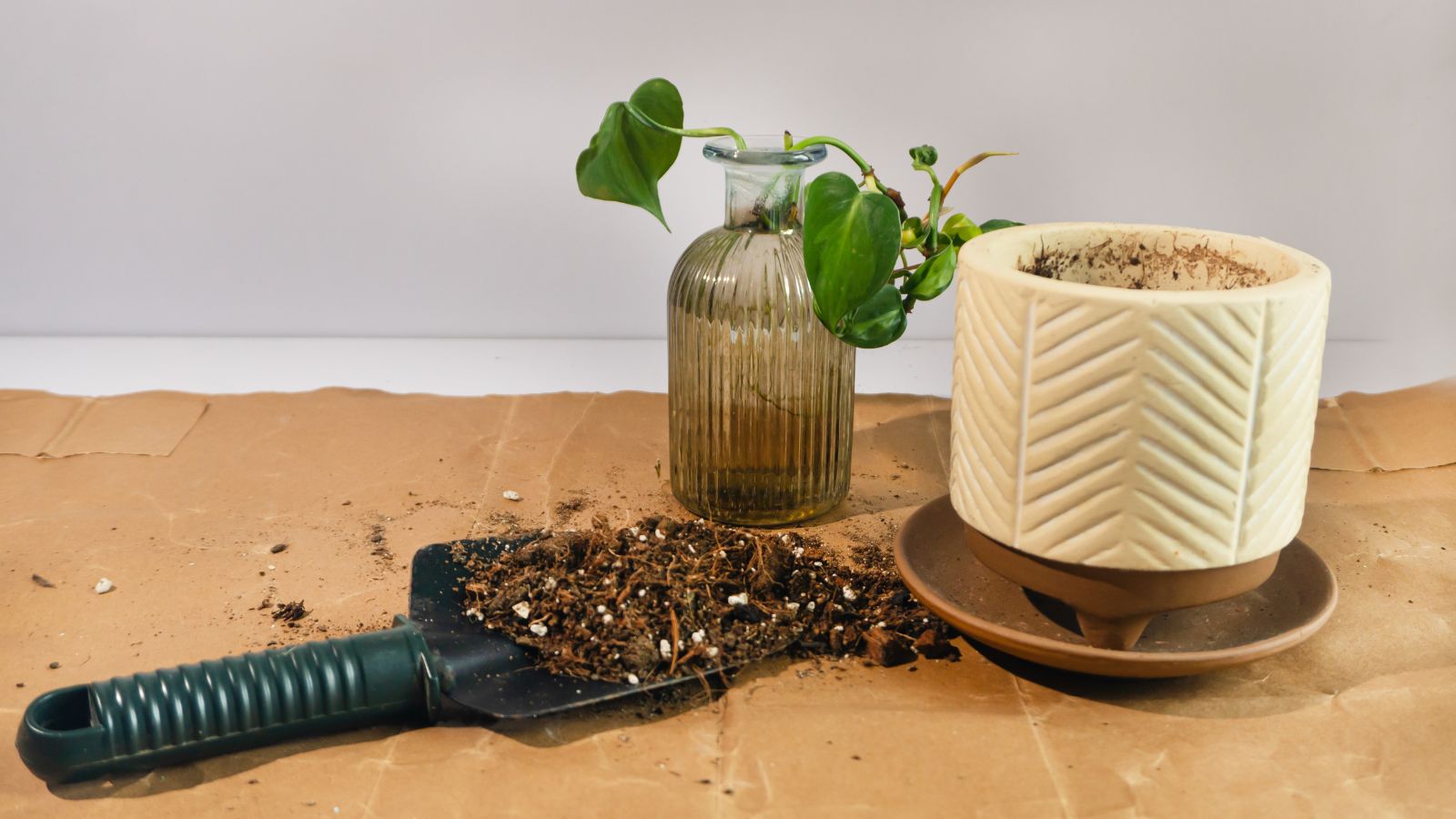
Repotting is an important part of houseplant care, but it is best not to rush the process. Avoid repotting immediately after bringing a plant home unless it is severely rootbound. Repotting disturbs the root system and changes the growing conditions, which can stress the plant and lead to transplant shock.
Only repot Philodendron ‘Brasil’ when the roots fill the pot or when the soil has degraded after several years without refreshment. Choose a container one or two sizes larger than the current pot. Slightly snug conditions support healthy growth, while excess soil retains too much moisture and increases the risk of fungal issues and root rot.
Carefully remove the plant from its pot and gently loosen old soil from the roots. Add fresh houseplant potting mix to the new container, filling it about one-third full. Position the plant so the base sits just below the rim of the pot.
Fill in around the roots with additional soil, pressing lightly to remove large air pockets. Leave a small gap between the soil surface and the rim of the pot to prevent water from spilling over during irrigation. Firm the soil gently to stabilize the plant.
Water thoroughly immediately after repotting to help settle the soil and reduce transplant shock. Return the plant to its previous location so light and temperature conditions remain consistent while it adjusts.
Common Problems

While they are relatively carefree plants, they are not without problems. From watering issues to lack of humidity or pests and diseases, there are a few signs that your plant is struggling. Luckily, there are also plenty of fixes to get your plant back to good health in no time.
- Yellow leaves: Typically caused by overwatering. Adjust your watering frequency and repot if leaves start to wilt due to root rot. Can also signal nutrient issues, most commonly due to over-fertilizing. Flush the soil with distilled water and hold off on fertilizing for several months.
- Brown leaves: Brown tips indicate a moisture issue, usually underwatering or lack of humidity. Brown spots in the centers of the leaves in areas of the plant facing the light source indicate leaf scorch. Move the plant to a spot away from harsh direct sun or cover the window with a sheer curtain.
- Wilting or curling: Usually due to underwatering, but also caused by overwatering. Check the soil moisture to determine which is more likely and change your watering frequency to manage the problem. Curling is also a response to direct sunlight as the plant tries to protect itself and conserve moisture.
- Spots on leaves: Caused by common houseplant pests like spider mites or mealybugs that feed on leaf tissue. Remove with insecticidal soaps or horticultural oil.
- Lack of variegation: Receding variegation is caused by low lighting conditions. Move the plant to a spot with bright indirect light and the variegation should return to normal, and may even expand.
Frequently Asked Questions
Can Philodendron ‘Brasil’ grow in water alone?
Due to their ability to root in water, Philodendron ‘Brasil’ can also grow in water long-term. However, you will need to add a few drops of fertilizer to the water to provide the plant with essential nutrients.
Only cuttings should be grown in water long term – plants originally in soil should not be moved to water or they may encounter root rot.
Is this variety considered rare?
As one of the oldest cultivars, they are not rare and can be commonly found in local nurseries or reputable online stores.
Is Philodendron ‘Brasil’ a pothos?
Philodendron ‘Brasil’ is part of the same plant family as the pothos, but they are not the same plant. ‘Brasil’ is part of the Philodendron genus, while the pothos is botanically known as Epipremnum aureum.
If you have trouble telling them apart, take a look at our guide detailing the differences between the philodendron and the pothos.
Can they grow in low light?
Heartleaf philodendrons manage in lower lighting conditions. However, for ‘Brasil’ to maintain its high levels of variegation, bright indirect light is preferred.
How can I make a Philodendron ‘Brasil’ bushier?
Pruning long trailing stems will keep the plant compact and encourage bushier growth. Prune just above a node, leaving it on the plant to encourage new growth at that point.
Is Philodendron ‘Brasil’ toxic?
Philodendron ‘Brasil’, like other heartleaf philodendrons, is toxic to humans and pets. For this reason, it should be stored away from both pets and small children that may find it too difficult to resist putting in their mouth.