How to Plant, Grow, and Care for Daikon Radish
Daikon cost a lot, but by growing daikon radish at home can save money and improve your soil at the same time. They're great for fitting into gaps in your garden beds, making wonderful companion plants. Our guide shares how to get it right!

Contents
Want a vegetable that is good for you and your garden? Growing daikon radish fits the bill. Known for its long, icicle-like roots and large, leafy tops, daikon provides mild-flavored, nutrient-rich harvests while also helping to break up compacted soil in the garden.
Daikon radishes, or Raphanus sativus var. longipinnatus, were first cultivated in East Asia, specifically northern China. Varieties are also native to Japan, India, Malaysia, and Singapore. Today, daikon is grown and used around the world, both as a food crop and as a cover crop to improve soil health. Its deep taproot penetrates compacted ground, loosening the soil and improving conditions for future plantings.
Most daikon radishes weigh between one and two pounds. The largest daikon ever recorded was grown in Kagoshima City, Japan, and weighed approximately 73 pounds. It also measured more than two feet across. This giant variety, known as Sakurajima, thrives in the region’s volcanic soils.
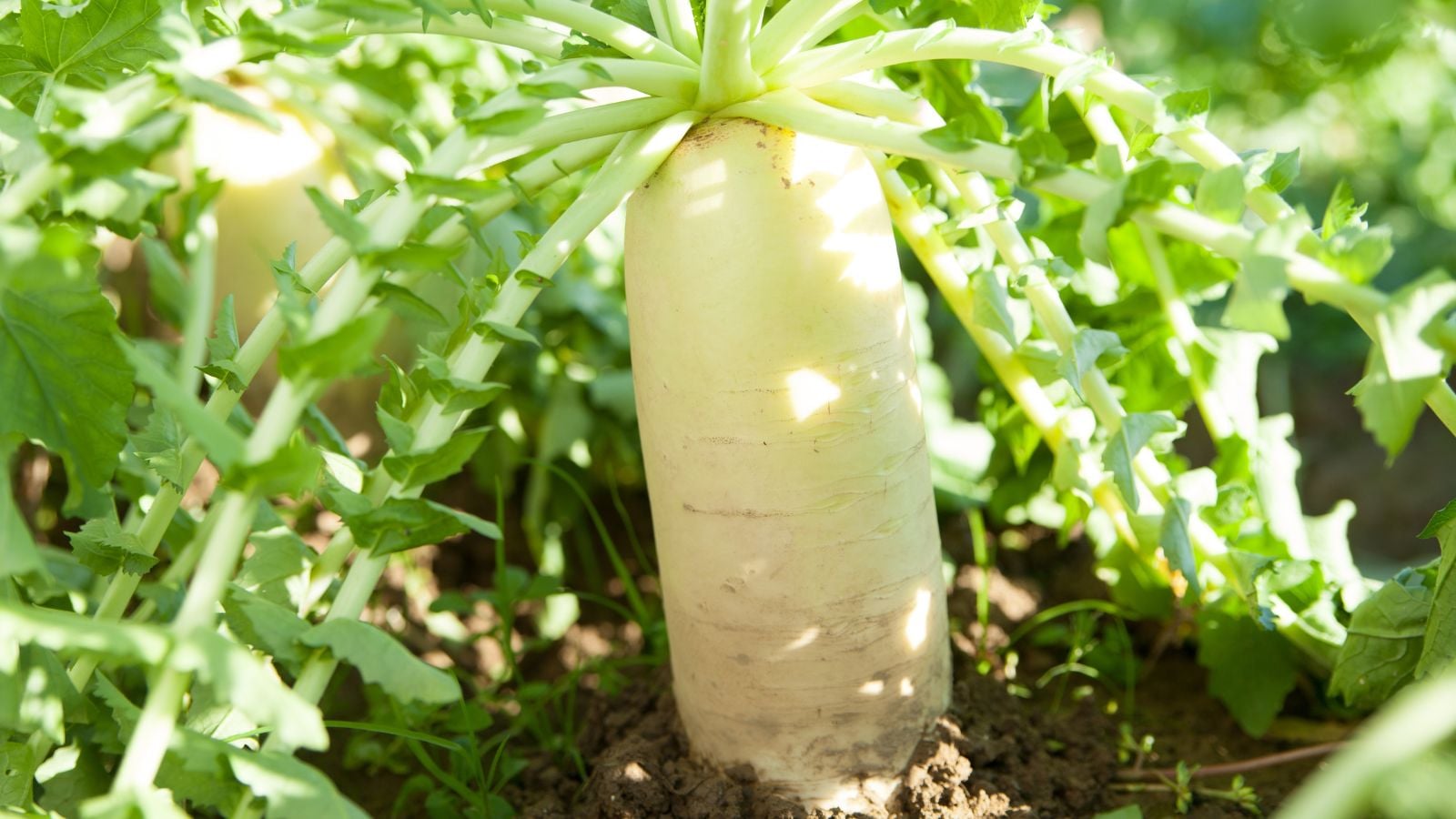
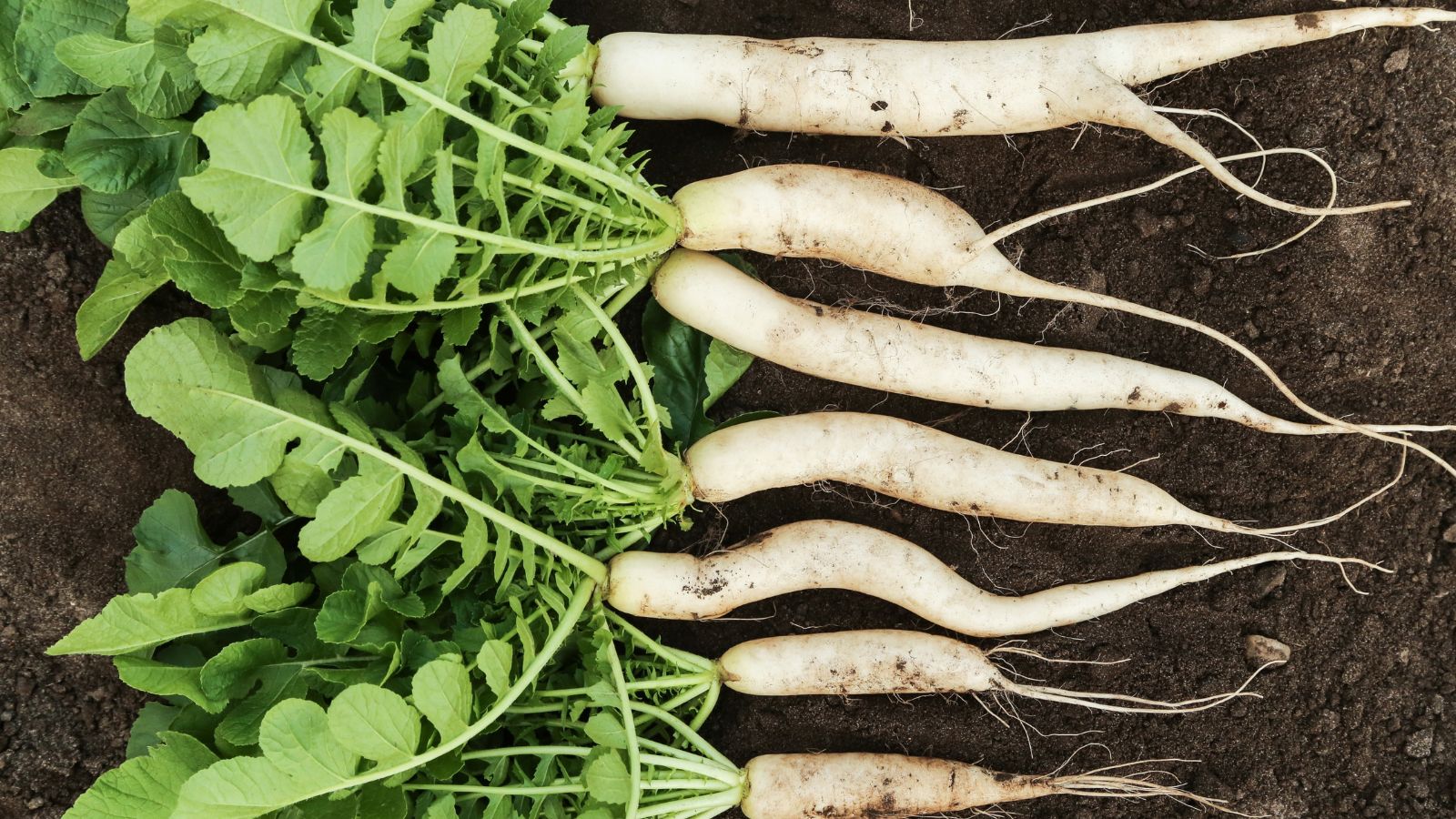
The typical daikon variety does not share the same shape as Sakurajima. Most types are long and cylindrical with smooth white skin, although many cultivars display different shapes, sizes, and colors. Leaves grow from the top of the root and are also edible. Daikon can be eaten fresh, pickled, or cooked into soups and other dishes.
Daikon radishes are easy to grow when planted at the right time of year. Once established, they improve soil structure as they grow. After harvesting daikon and enjoying the loosened garden bed they leave behind, you can easily plant other crops, including nightshades, in their place.
Miyashige White Daikon Radish Seeds

Young daikon radishes are often used shredded in sushi, but their light, slightly spicy flavor is a unique addition to many other dishes. Mature daikon is pickled or cooked; add to stir-fries or soups for crunch. Daikon is a winter radish, requiring shortening day length and cool temperatures to form.
Buy at Epic Gardening ShopQuick Care Guide

|
Scientific Name
Raphanus raphanistrum subsp. sativus
Days to Harvest
30-80 days to maturity, depending on the variety
Light
Full sun to partial shade
Water
Keep moist, but not wet
|
Soil
Well-draining, amended with compost up to 8 inches from the surface; pH of 5.8-6.8
Fertilizer
Avoid high nitrogen fertilizers; full spectrum 2x/season is enough
Pests
Flea beetles, cutworms, cabbage loopers, aphids, harlequin beetles
Diseases
Black root, downy mildew, fusarium wilt, clubroot, alternaria blight, white rust, wirestem
|
All About Daikon Radish

Raphanus raphanistrum subsp. sativus, daikon radishes are known as mooli in India and the UK, and chai tau in Thailand and Taiwan. Other common names include white radish, winter radish, and icicle radish. Daikon is a type of Chinese radish that was systematically introduced to surrounding countries, where it remains popular today. The name daikon comes from Japanese and translates to “big root.”
The daikon taproot ranges in color from pale white to deep red, depending on the variety. To photosynthesize efficiently, daikon radishes produce abundant leafy greens that radiate from the crown of the root. If allowed to bolt, plants form small seed pods that resemble miniature green beans. These pods have a strong mustard-like flavor and can be eaten fresh or added to salads.
Eventually, bolting plants produce delicate white flowers, which signals a major change in flavor. Daikon roots harvested after flowering are extremely bitter and should be avoided.
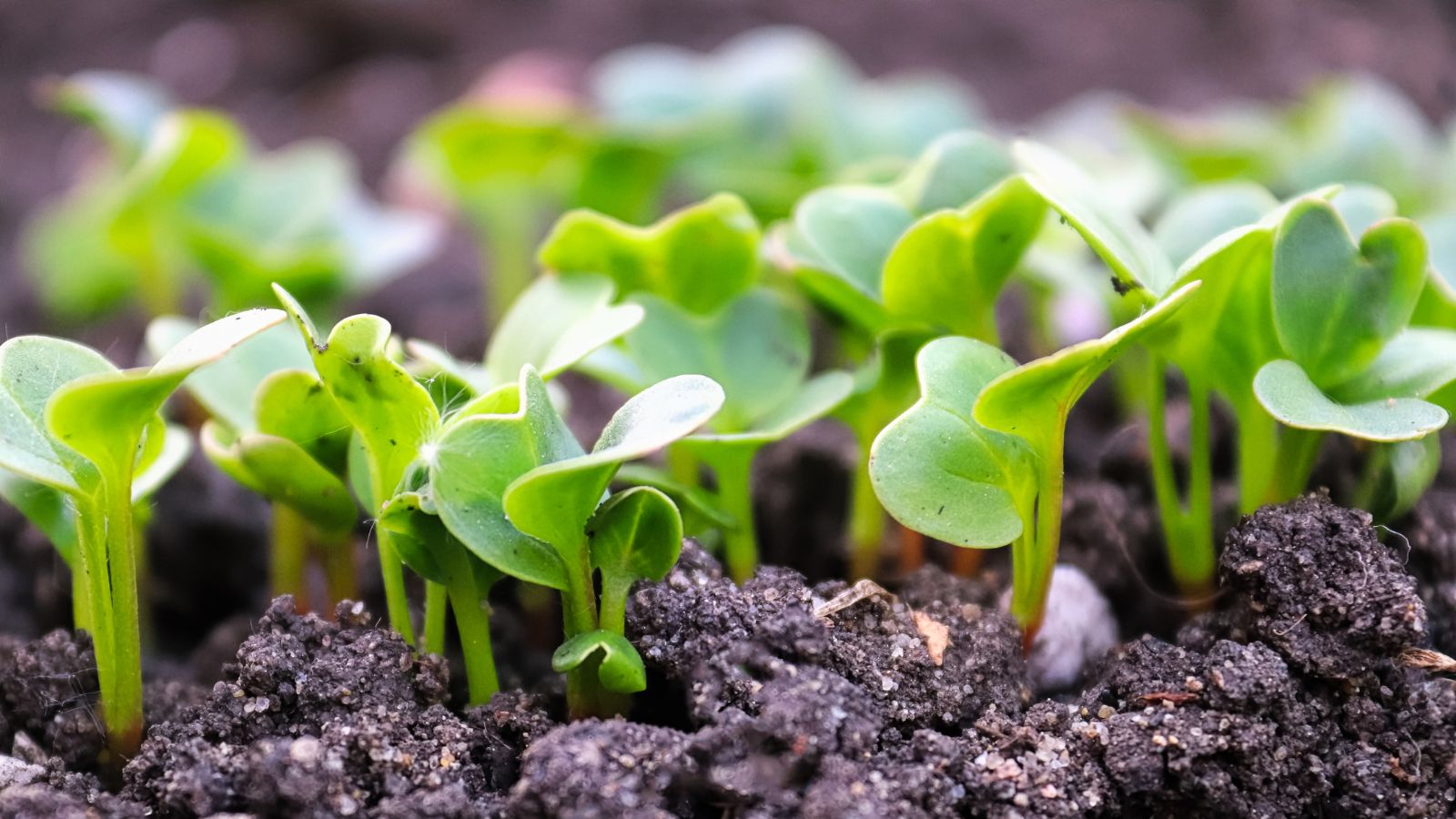
Daikon plants perform best before the first frost, which is why seeds are typically sown in late summer or early fall. Spring plantings are usually unsuccessful, as daikon does not tolerate high heat well. Seedlings emerge with heart-shaped cotyledons, followed by serrated true leaves. Over 30 to 80 days, a mature taproot develops, and the top of the root becomes visible at the soil surface when it is ready for harvest.
Uses
While the greens are edible and used in cooking, the taproot is the primary harvest. Traditionally, daikon is chopped or julienned and pickled to serve as a fresh side dish. Its mild flavor makes it popular in raw salads, and it is also commonly cooked in soups or simmered with chicken and leafy greens. Historical records suggest that daikon was grated and eaten raw during the Edo period in Japan as a digestive aid.
One standout variety is ‘Watermelon Radish’, which has pale green skin and a vivid pink interior. Unlike the more familiar cylindrical types, this variety is round and compact, with a flavor that is both sweet and mildly spicy. It makes a striking addition to raw vegetable platters.
No matter which variety you choose, daikon offers an impressive range of shapes, sizes, and colors. With such a long global history of cultivation, there are countless heirloom varieties worth exploring.

Planting
Sprouting daikon radish is simple, largely because it is such an easygoing plant. Wait until late summer or early fall (not spring) to sow seed directly into lightly amended soil, as you would with other radishes. While many vegetables and other radish types grow well in containers or grow bags, daikon is not well-suited to either.
Daikon requires significant soil depth, so seeds should be planted in an in-ground bed or a raised bed. These plants must be grown outdoors in an area that receives full to dappled sunlight. To sow, create rows and place seeds along them, then thin seedlings as they develop to give each plant enough space to form a full taproot.
How to Grow
Grow daikon radishes and watch them mature quickly. Avoid over-fertilizing at planting time, as excess nutrients can encourage leafy growth at the expense of the root. When grown correctly, the taproots develop deeply, naturally loosening and improving the soil below.
Light

Daikon grows best in full sun to partial sun, with at least six hours of sunlight per day. Intense, harsh sunlight can damage the leaves, which in turn affects root development.
Water

In warm weather, water daikon radishes daily during the morning hours, before ultraviolet rays have time to heat the soil. This helps prevent heat stress and stunted growth.
As temperatures cool, monitor soil moisture to determine when additional water is needed. The soil should remain moist but not saturated. To check, insert your finger about one inch into the soil. If it feels dry at that depth, water in the morning.
Drip irrigation is the best watering method for daikon. A steady, consistent drip applied in the morning provides the roots with even moisture without waterlogging the soil.
Soil

Daikon can be grown in poor, compacted clay soils, where its roots will still develop and help break up the ground. However, for best results, radishes thrive in well-draining soil amended with compost.
Most radishes prefer a soil pH between 5.8 and 6.8 to form healthy, edible roots. Daikon does not perform well in soil with high nitrogen levels, so testing your soil ahead of planting is recommended if excess nitrogen has been an issue in the past. Too much nitrogen can prevent proper root formation.
If moisture retention is a concern, apply mulch around the base of each seedling to help keep the soil evenly moist.
Temperature and Humidity

Daikon grows in USDA hardiness zones 2 to 11 and performs best at temperatures between 50 to 65°F (10 to 18°C), conditions that often extend into October. It can tolerate colder weather down to about 30°F (-1°C). Once temperatures drop below 20°F (-7°C), however, daikon radishes are at risk of crop failure. High spring heat is also problematic. Like most radishes, daikon prefers growing conditions below 80°F (27°C), as excessive heat can stunt root development.
If you need to grow daikon radishes later into the cold season, frost cloth can help protect crops until spring. Raised beds retain heat better than in-ground soil, increasing the chances of keeping foliage green and healthy. Keep in mind that forcing growth under these conditions can alter flavor.
Daikon also benefits from moderate to high humidity, so maintain consistent soil moisture and create stable growing conditions to support healthy growth.
Fertilizing

Daikon radish does not require much fertilizer, especially during colder months when it is best not to fertilize at all. When planted in properly amended soil, daikon generally needs no additional feeding. A compost tea applied once the plant is established and about halfway through the growing season can be beneficial, but it is not essential.
Avoid fertilizers high in nitrogen. Excess nitrogen in the soil or fertilizer will stunt root development and redirect the plant’s energy into leafy growth instead. If you choose to use a commercial fertilizer, select one with a lower nitrogen ratio relative to phosphorus and potassium. In many cases, no additional fertilizer at all produces the best results.
Propagation
There is only one way to propagate daikon, and that is by seed. Remember the pods that form when daikon becomes overmature, the ones with a pleasantly mustardy flavor? These are the seed pods. Allow them to fully develop, then collect them and place them in a paper bag. Once dry, the pods will split open, releasing the seeds inside.
Store the seeds until the next growing season, then sow them by October. This process is especially important for heirloom varieties, which depend on seed saving to continue from one generation to the next.
Harvesting

Like other radishes, daikon roots have an impressive shelf life. While the leaves do not store well, the roots themselves will keep for a long time when harvested and stored correctly, allowing you to enjoy them well after harvest.
When the leaves reach at least eight inches long in early winter, it is time to harvest. At this stage, the tops of the daikon roots will usually be visible above the soil surface. If you are unsure whether the roots are ready, it is fine to pull one plant and compare the size of the root to the foliage. It is important to harvest before heavy frost sets in, as freezing conditions can lead to root rot.
To harvest, grasp the bundle of leaves where they meet the root and pull upward. If you still have time before the first frost and notice that some roots are smaller than you would like, you can leave those plants in the ground to continue growing. Once harvested, the area where daikon was grown becomes a loose, nutrient-rich bed that is ideal for planting other root crops or nightshades.
Storing
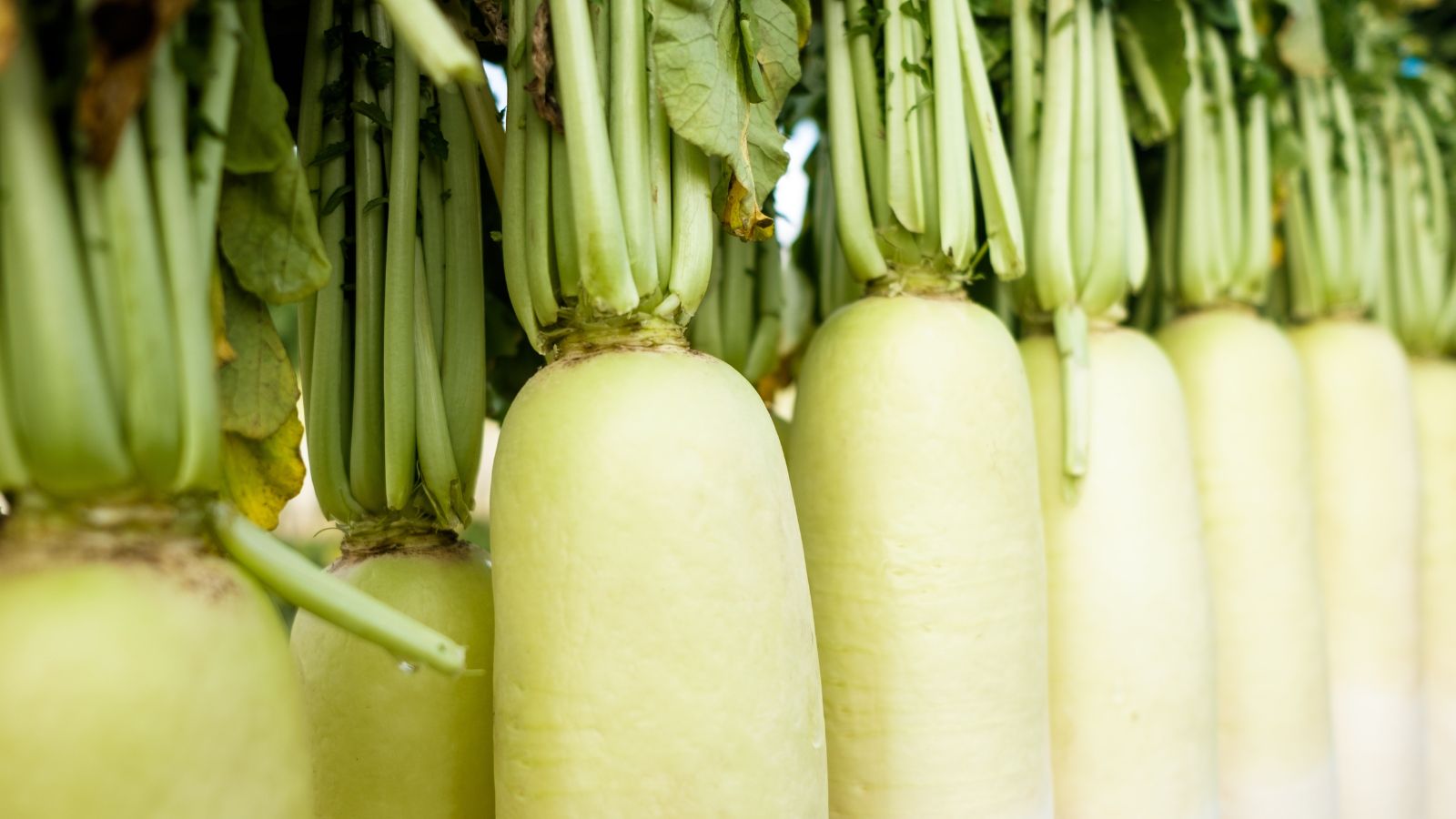
The green leaves of daikon can be eaten raw in salads or lightly wilted, but they only keep for a few days in the refrigerator. If the leaves are slightly wilted and salted, they can be stored in the freezer for up to one month. Leaves can also be removed and added to the compost as green material. Separating the leaves from the roots will help the radish store for longer overall.
To store daikon roots in the refrigerator, place them in a plastic bag or wrap them in a damp towel. Left too long in this condition, the roots may develop a woody texture.
Because daikon is rich in nutrients, pickling is an excellent long-term storage option and allows some harder-to-digest compounds to break down. Daikon can also be blanched briefly, chopped into large pieces, and frozen for up to one month. When sun-dried, daikon can last for up to six months.
Troubleshooting
Daikon is easy to work with under the right conditions. But it is susceptible to a variety of fungal conditions when it’s too cold and wet.
Growing Problems
High heat prevents proper root development in daikon. While these plants need warmth for seed germination, they grow best as temperatures cool. In hot weather, daikon is more likely to bolt. If you realize you planted at the wrong time, do not worry. Allow the plants to bolt and form seed pods, then collect the seeds for planting again in late summer.
If conditions are too cold or frosty, daikon roots may still form, but the crop is likely to rot. Be sure to harvest daikon before the first frost to avoid losses.
Excess water can also damage daikon roots. If the soil stays wet and does not dry properly, reduce watering. On the other hand, too little water can cause roots to crack and negatively affect flavor. Applying mulch helps reduce moisture evaporation and keeps soil conditions more stable.
Too much nitrogen pushes the plant’s energy into leaf growth rather than root formation. Prevent this by testing soil nutrients before planting. Many agricultural extension offices offer free soil test kits. If this has been a recurring issue, testing the soil ahead of each planting season is especially important.
Overcrowding also interferes with taproot development in radishes. Thin seedlings once true leaves appear, spacing plants at least a few inches apart, even if seeds were initially sown one inch apart. Keep rows spaced 18 to 20 inches apart from the beginning to ensure adequate room for root growth.
Pests

Daikon crops show signs of flea beetle infestation when small, round, web-like holes appear on the leaves. It is often easier to look for damage rather than the insects themselves, as flea beetle appearance varies widely between species. To control flea beetles, handpick them when possible or use sticky traps to attract and kill them. Sprinkling diatomaceous earth around the base of plants helps prevent flea beetles from reaching the foliage.
Cutworms are another pest that daikon crops must contend with. These insects chew through the base of young plants as they feed and later pupate into moths, which do not cause garden damage. Prevent cutworms by placing a physical barrier around the base of seedlings that extends a few inches into the soil. If you spot cutworms during the day, handpick them and drop them into soapy water. If treatment is necessary, use BT (Bacillus thuringiensis) to limit further damage.
Cabbage loopers feed on daikon leaves, making it difficult for the plant to direct energy toward root development. They can also consume leaves before they fully mature. In healthy gardens, birds and beneficial insects often help control looper populations.
Aphids also feed on daikon foliage before roots reach maturity. Check the undersides of leaves regularly for signs of infestation. Aphids vary in color but share a similar appearance: small, rounded, and usually present in large numbers. Encourage beneficial insects such as ladybugs, which feed on aphids, or spray plants with neem oil, which aphids strongly dislike.
Diseases

Black root (Aphanomyces raphani) is a fungal disease that rots radish roots and develops when conditions are excessively wet. It can occur at any stage of the radish life cycle. There is no treatment for black root beyond prevention. Avoid cool, waterlogged conditions, and promptly remove and destroy infected plants. Do not compost affected material.
Fusarium wilt, caused by the fungus Fusarium oxysporum, is another disease associated with cool, wet soil conditions. While some bacterial and fungal soil amendments show promise in suppressing fusarium, prevention remains the most effective approach.
Clubroot, also a fungal disease, affects radishes by causing severe root deformation. If you notice stunted leaf growth, pull up a daikon to inspect the roots. Infected plants should be destroyed and not composted.
Downy mildew is a fungal disease that thrives in high moisture and high humidity. Although copper fungicides can be used for treatment, this disease is persistent and difficult to eradicate once established. Avoid composting any plant material infected with downy mildew.
Alternaria blight develops when growing conditions are poor and presents as brown spotting on leaves. Applying a liquid copper fungicide can help prevent the spread of this highly infectious disease.
White rust causes spore-like growths to collect on leaves and can also be treated with copper fungicide.
If you notice a dark lesion at the base of daikon seedlings, wirestem caused by Rhizoctonia solani is the likely culprit. This disease causes seedlings to take on a bluish cast and weaken at the soil line. Copper fungicides can help manage infected plants after transplanting.
Frequently Asked Questions
How long does it take to grow daikon radish?
It depends on the variety. Some species take just 30 days to mature, and some take up to 80. Select a variety that suits your needs, and take into consideration the first projected frost date. This gives you an idea of how many days you have until daikon should be harvested.
Can you regrow daikon radish?
Unfortunately once they have been harvested, daikon taproots cannot be regrown. If you enjoy the greens, however, they will continue to proliferate if replanted.
Is daikon radish perennial?
Daikon radishes are annuals that enjoy increasingly cool soil temperatures in their maturation process. They will produce once per year near the first frost date.