
We all love trees and shrubs that have beautiful fall color. We also love birds and butterflies. We can help these creatures by asking for native plants when we shop at garden centers.
See: 16 Invasive Species Sold at Garden Centers You Should Never Buy
Butterflies need native plants to reproduce successfully and produce caterpillars. Birds need butterfly caterpillars to feed their nestlings. We can enjoy colorful fall beauty and birds and butterflies.
Here’s a list of eight must-have native shrubs and trees that provide beautiful fall color and support wildlife.
Listen to this post on the Epic Gardening Podcast
Subscribe to the Epic Gardening Podcast on iTunes
This article is courtesy of the following author:
Charlotte Adelman, with her husband Bernard L. Schwartz, is the author of Midwestern Native Shrubs and Trees: Gardening Alternatives to Nonnative Species, An Illustrated Guide, the companion book to The Midwestern Native Garden: Native Alternatives to Nonnative Flowers and Plants (winner of the 2012 Helen Hull Award from the National Garden Clubs); and Prairie Directory of North America – The United States, Canada, and Mexico. In 2014, Adelman was awarded an Audubon Chicago Region Habitat Project Conservation Leadership Award.
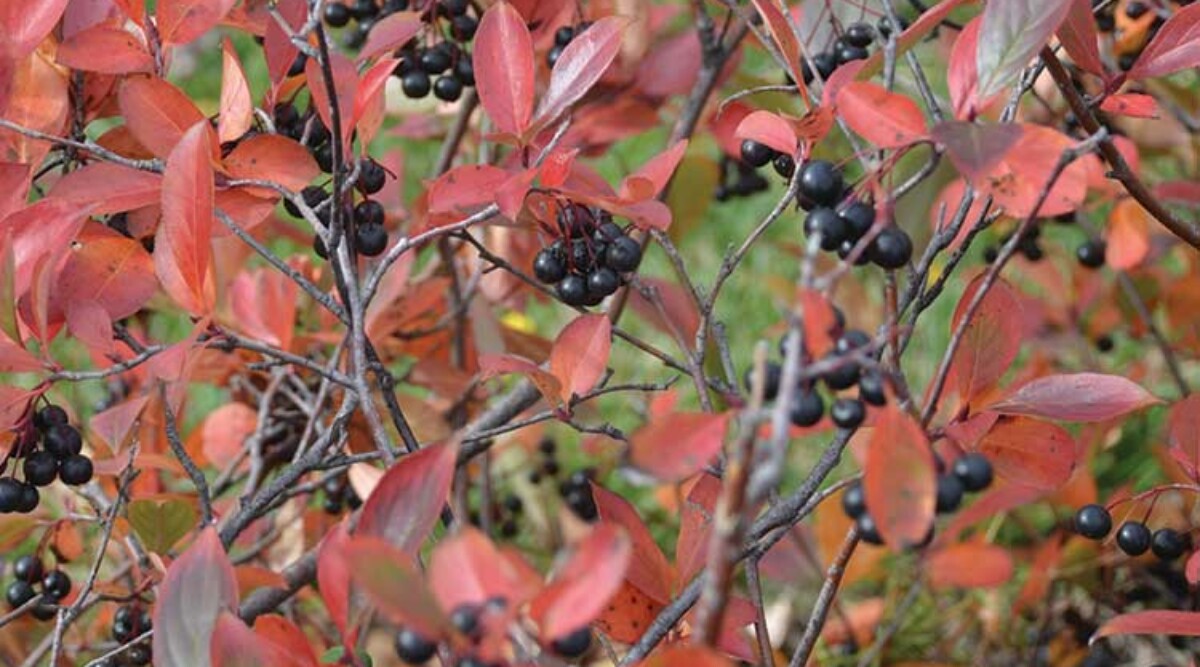
1 – Chokeberry (Aronia)
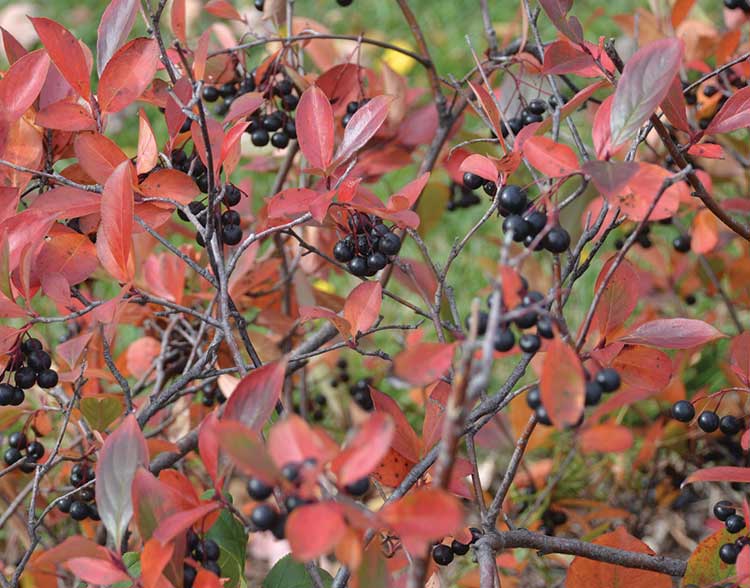
- Black Chokeberry (A. melanocarpa)
- Red Chokeberry (A. arbutifolia)
The hardy, adaptable, and trouble free chokeberry shrubs provide four-season beauty and food for wildlife. Full sun and moist, well-drained sites are best for flowers and fruit. Bees love their showy displays of fragrant white flowers in spring, and later, brilliant red leaves make fall sing. Best of all, their fruits provide winter food for 21 species of birds, including mockingbirds, grackles, and catbirds, and chokeberries host 29 species of butterflies and moths, producing caterpillars that in turn feed nestlings of many favorite birds.
2 – Viburnum
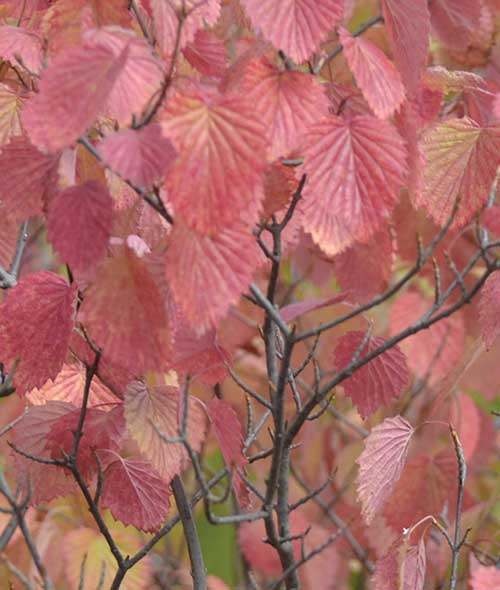
- Black-haw Viburnum (Viburnum prunifolium)
- Arrowwood Viburnum (Viburnum dentatum var. dentatum)
Vibrant colors are in store if you plant these native alternatives to the Asian viburnums that nurseries often promote. In fall, arrowwoods become red, yellow or purple, while black-haws turn purple and red. In spring, white, often fragrant spring flowers invite butterflies and small pollinators that attract nesting birds seeking insect food for their offspring. Blue-black berries attract 35 bird species, including blue jays, redpolls, and flycatchers. Arrowwood berries’ high fat content makes them an essential food source for over-wintering and migrating birds. Native viburnums host 35 species of Lepidoptera (butterflies and moths), including the hummingbird clearwing moth.
3 – Ninebark (Physocarpus opulifolius)
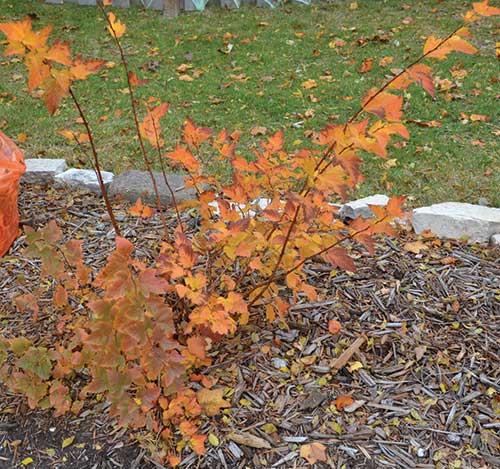
For bright red, orange, or yellow autumn foliage, look no further than native ninebark. In winter, exfoliating bark provides decorative interest. Papery red fruit clings into winter unless eaten by birds. Ninebark hosts 41 species of Lepidoptera, as well as the ninebark calligraphy beetle.
Don’t confuse the green-leaved native species with the purple-leaved cultivar, like “Diablo” and “Summer Wine,” available in many nurseries. Turning leaves purple creates a chemical change that makes them indigestible to dependent insects. Nor is ninebark the only “nativar” with this problem—be wary of purple-leaved versions of American black elderberry, redbud, and American smoke bush. They are often marketed as pest resistant, but making these plants inaccessible to native insects deprives adult and baby birds of an important food source.
4 – Serviceberry, Juneberry (Amelanchier species)
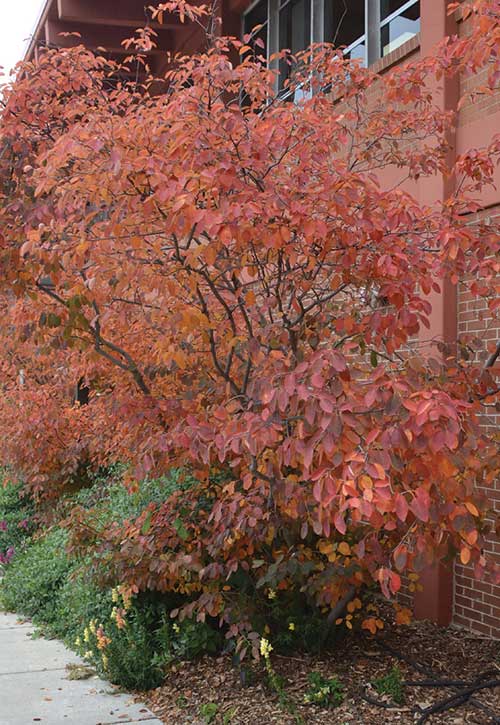
Looking for an alternative to the nonnative, invasive burning bush? Serviceberries, or Juneberries, provide blazing red, orange or yellow fall color at the same time. And their fragrant white flowers in spring appear the same time as those of the nonnative, invasive Bradford pear. Don’t miss their berries, which appear in—you guessed it—June, and are delicious for birds and humans alike. Serviceberries can be raised single stemmed or many stemmed, as small trees or shrubs, and host 124 Lepidoptera species. Birds they attract include Baltimore oriole, wood thrush, catbird, tufted titmouse, and ruby-throated hummingbirds. And, they have special value to important pollinators, including native bees.
5 – Redbud (Cercis canadensis)
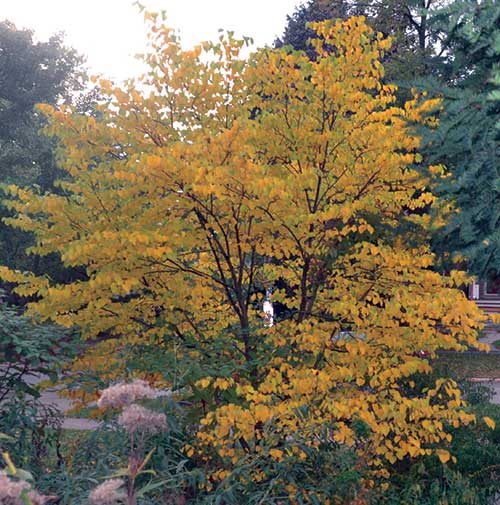
Eastern Redbud’s delicate heart-shaped green leaves turn strikingly yellow in fall, and the tree’s irregular branching patterns are eye-catching in winter. The gorgeous, magenta-pink, early spring blossoms attract early-season butterflies and other nectar-seeking insects. The flowers also have special value to native bees, their primary pollinators. Chickadee, northern cardinals, and rose-breasted grosbeak eat the seeds. Redbud hosts 19 species of butterflies and moths including Henry’s elfin.
Do avoid the landscape-industry-created redbud nativars—such as “Forest Pansy” —which feature white flowers instead of magenta-pink, and have variegated or purple/maroon leaves.
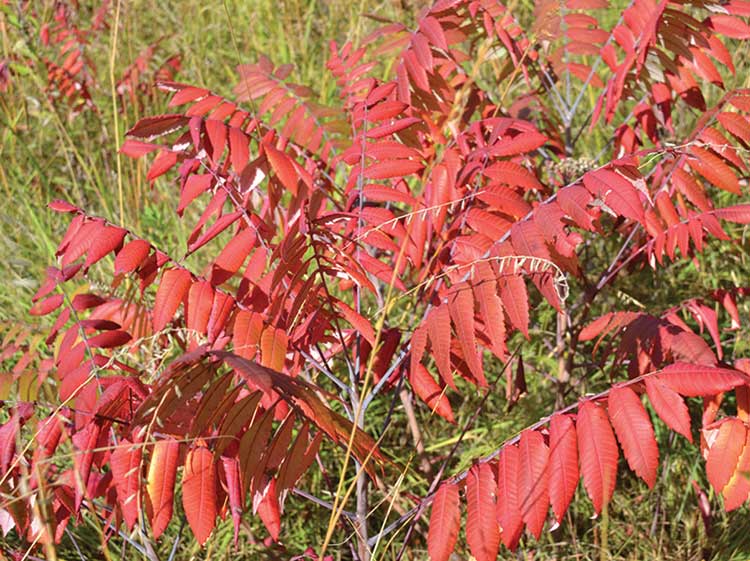
6 – Sumac (Rhus species)
- Fragrant sumac (Rhus aromatica)
- Smooth Sumac (Rhus glabra)
- Staghorn sumac (Rhus typhina)
Don’t miss sumacs’ orange, purple, and red fall show. Better yet, these low-maintenance plants only need mowing or occasional pruning. Readily available species are smooth sumac (Rhus glabra), and staghorn sumac (Rhus typhina). Both grow 10 to 15 feet tall and wide and have bright red fall colors and showy red berries. Staghorn sumac branches feel like velvety antlers. Fragrant sumac (Rhus aromatica) grows two to five feet tall and five to ten feet wide. Its fragrant leaves turn a mixture of red, burgundy, purple, and green in fall. Sumacs attract native bees and various pollinating flies that birds feed nestlings. Small carpenter bees use the stems to create tunnel-nests and reproduce. Sumacs host 58 species of Lepidoptera including spring and summer azure butterflies and the luna moth. More than 98 species of birds eat sumac fruits, summer through winter, including American robins, red-eyed vireos, purple finches, wild turkeys, eastern towhees, eastern bluebirds, and scarlet tanagers. Sumac flowers attract native bees and various pollinating flies that birds feed their hungry nestlings. But, do avoid the nativar, Rhus aromatica (“Gro-Low”) which neither flowers nor fruits, leaving wildlife without sustenance.
7 – Birch (Betula)
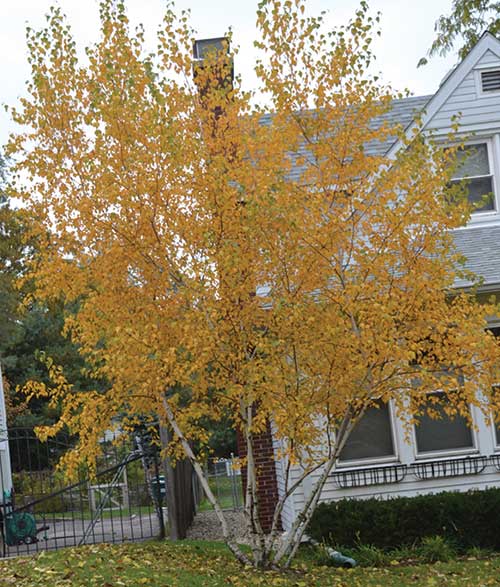
- Canoe, Paper or White Birch (Betula papyrifera)
This iconic tree’s golden fall leaves and showy white bark makes it a real beauty. Like other native birches, it is more borer resistant than European and Asian birch species. Native birches host 413 butterfly and moth species and feed more than 35 bird species. Canoe birch’s exfoliating bark provides over-wintering insects with hiding places, supplying woodpeckers with food when they need it most.
8 – Oak (Quercus)
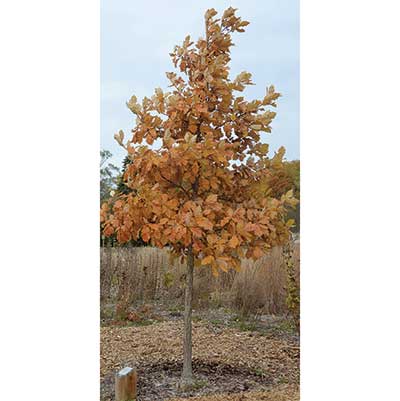
- Swamp White Oak, Bicolor Oak (Quercus bicolor)
In fall, the round-lobed leaves of the swamp white oak turn orange-gold, yellow, or reddish-purple. Wildlife that dines on oak acorns include deer, gray and red squirrels, chipmunks, wild turkeys, crows, flying squirrels, rabbits, opossums, blue jays, quail, raccoons, gray and red foxes, mallards, and wood ducks. More than 60 species of birds use oak trees for shelter and nesting. And, native oaks host 534 species of butterflies and moths, more species than any other known plant.
All images in this article are credit of “Midwestern Native Shrubs and Trees – Gardening Alternatives to Nonnative Species, An Illustrated Guide,” by Charlotte Adelman & Bernard L. Schwartz, Ohio University Press.



